What belongs in your au pair contract?
· NannyTank
Protect Yourself · NannyTank
A contract isn't about distrust. It's the thing that protects both of you when memories disagree six months from now. If you don't have one in writing, this is your nudge.
The essentials
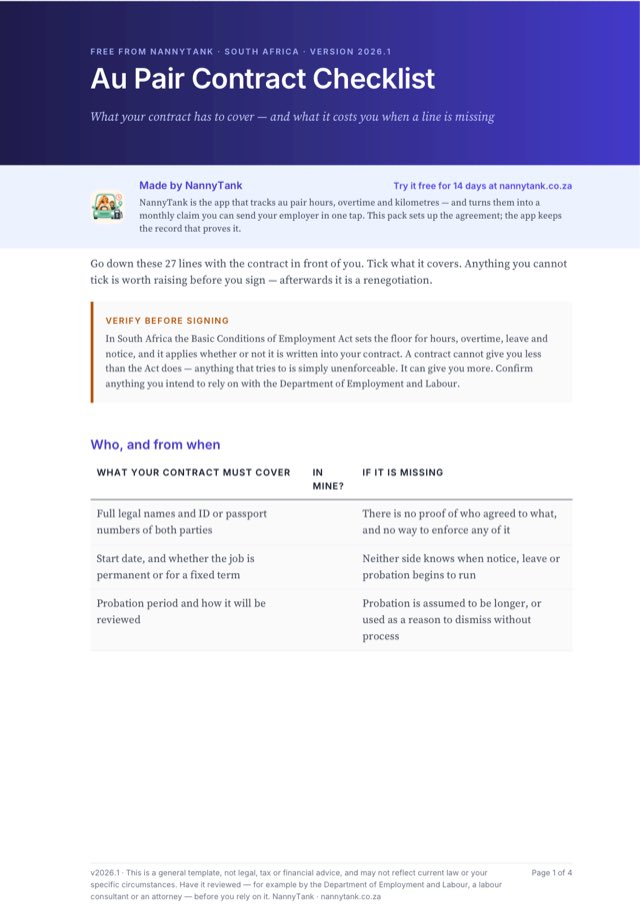
A good au pair agreement should spell out, at minimum:
- Your normal hours — daily start/end times and a weekly maximum.
- Your pay — hourly or fixed monthly, and the exact payday.
- Your overtime rate — what you're paid for hours beyond normal.
- Driving & reimbursement — whether you use your car, and the km rate.
- Days off and leave — weekly rest days, sick days, vacation.
- Your duties — childcare yes, but be clear on cleaning, cooking, pets.
- Notice period — how much warning either side gives to end things.
Why "we'll just keep it casual" backfires
Casual arrangements feel friendly at the start. The problem comes later — when you've worked extra hours, or want to take leave, or the family's expectations have quietly grown. With nothing written down, every disagreement becomes your word against theirs. A contract turns those moments into a quick "let's check what we agreed."
A contract is only as good as your records
Here's the part people miss: a contract sets the baseline, but it can't prove what actually happened day to day. Your contract says 45 hours; your records show you worked 52. You need both — the agreement and the log that measures reality against it.
Where NannyTank fits
NannyTank holds your agreed normal hours and pay setup, then quietly measures every real day against them. When something doesn't match the contract — extra hours, uncounted trips — it's already in black and white, ready to show. The contract protects you; the record proves you.
Start your 14-day free trial at nannytank.co.za.