Your au pair recommended this.

They recommend the two of you use it together, so month-end stops being an admin job for either of you — they log their own hours and kilometres as they work, and the claim arrives at the end of the month already worked out. Here is what that means for you.

For host families · South Africa

You hired childcare. Nobody mentioned you’d also be running a payroll.

A contract you are not sure is compliant. A minimum wage that moves every March. An overtime rate nobody explained. And a sum to check every month — with someone who lives in your house and looks after your children.

See what it costs →

Approving their claim is free, always. No account, no payment, ever.

This is month-end.

One email. The sums already done.

Your au pair — June EXAMPLE
Hours worked 168.5 h
Overtime 9.5 h @ R37.50
Kilometres 214 km @ R4.95
Total to pay R8 968
✓  Approve

One tap, in the email. Free forever — no account, no payment, ever.

The job you did not apply for

None of this was in the plan when you decided you needed help with the school run.

Working out what they are owed

Their hours, the afternoons that ran late, the Saturday, the kilometres. Then the overtime multiplier, which is not the same as their normal rate.

The money conversation

Querying a number with someone who is inside your family life is uncomfortable for both of you. Most families just pay what is asked and hope it was right.

Registrations you have probably not done

UIF is the employer’s duty and runs through uFiling, not SARS eFiling. COIDA applies to domestic workers too. Neither is difficult; both are easy to never get round to.

Records you are required to keep

The BCEA requires a record of hours and payments, and a payslip every time you pay them. Where there is no record, your version is not the one that is assumed correct.

What actually changes

Nothing about the arrangement. Only who does the arithmetic, and when.

Their hours

Written down somewhere — a notebook, their phone, a spreadsheet they rebuild each month

→ Logged as they work, on their phone, in seconds

The overtime

Worked out by one of you, from memory, against a rate you agreed months ago

→ Applied automatically, at the rate the two of you set

Their kilometres

Guessed, or reconstructed at month-end, or quietly not claimed at all

→ Logged trip by trip at your agreed rate

Month-end

Somebody’s evening. One of you adds it up, the other one checks it

→ One claim arrives, already totalled. You approve it in a tap

Last March

In an inbox somewhere, or nowhere

→ Every claim kept, with a payslip PDF and the UIF worked out

They do the logging. You do nothing you are not already doing — except less of it.

How the month actually goes

1

They log their day, as they work

Start and finish times, the trips they drove. It takes them a minute and it is their habit, not your task. Nothing is asked of you.

2

At month-end, one claim arrives — already right

Hours, overtime at the rate you agreed, and kilometres, totalled. No spreadsheet, no mental arithmetic, and nothing to query because you are both looking at the same numbers.

3

You approve it and pay them

One tap in the email. Free, no account, no payment — forever. Then the payslip is there when you want it, with the UIF worked out.

One app, two sides

They use it every day. You see the month.

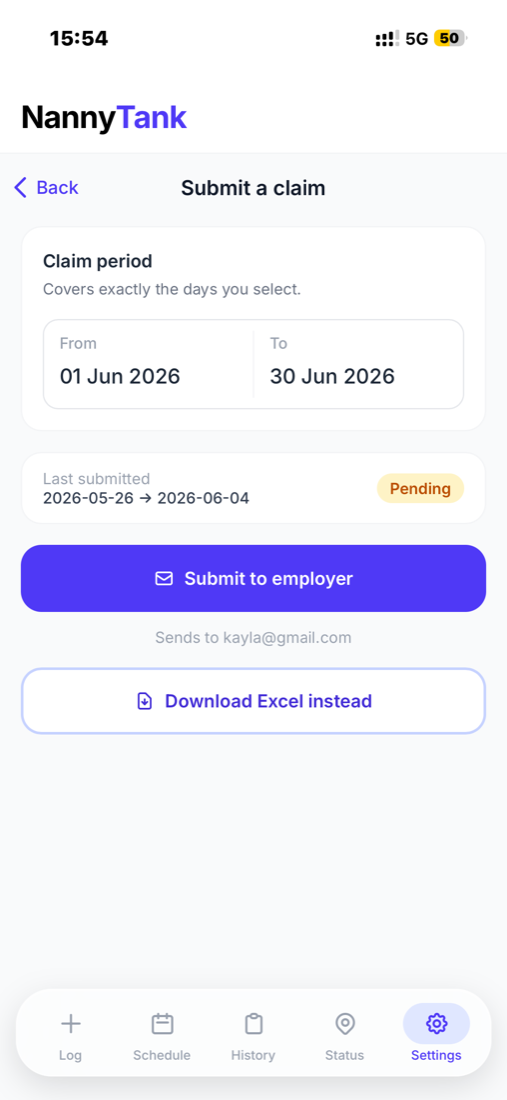
The NannyTank app, submitting a monthly claim

What they get

  • ✓ Hours and overtime totalled for them, at the agreed rates
  • ✓ Kilometres and fuel logged trip by trip, with saved routes
  • ✓ A claim that builds itself instead of an evening with a spreadsheet
  • ✓ A record that is theirs, and that they keep if they leave

What you get

  • ✓ One correct claim a month, to approve in a single tap
  • ✓ A payslip PDF each month, with the employee UIF worked out
  • ✓ Every claim kept, so a year is not reconstructed from memory
  • ✓ A shared schedule, and the children’s day written up

What this is not

It is not a way to check up on your au pair. There is no location tracking, no geo-fencing, no arrival alerts and no punctuality score — not as a setting you can switch on, but because they were never built.

You see nothing of their day unless they connect you, and connecting is a six-character code they generate and choose to share. The record belongs to them. You receive a claim, you approve it, you pay it — which is what the relationship already was, only with the arithmetic done.

If you are looking for monitoring software, this is the wrong product, and we would rather tell you now.

What it costs

Approving a claim is free and always will be. These are the optional extras.

The employer view

If they already use NannyTank

R699 once

14 days free first · no subscription, no renewal

See what’s included

Their app and yours

They’re placed, the contract is done

R1 099 once

A licence for them and the employer view for you · sold worldwide

See what’s included
Just hired someone

Set them up properly

Contract, their app, your payslips

R1 299 once

The BCEA contract pack, a licence for them, and everything in the employer view

See what’s included →

Questions host families ask

Is an au pair an employee in South Africa?

+

Generally yes. The Basic Conditions of Employment Act defines a domestic worker as someone employed in a private household, and it names childminding among the work that counts. Calling the arrangement an au pair placement does not put it outside the Act. In practice that means a written contract, the National Minimum Wage, overtime, leave and notice all apply.

Do I have to register my au pair for UIF?

+

If they work more than 24 hours a month for you, registration is the employer's duty, not theirs, and it is done through uFiling rather than SARS eFiling. Employer and employee each contribute 1% of remuneration up to a monthly earnings ceiling. Their 1% comes off their pay; yours does not — it is your cost on top of their wage.

Am I supposed to give my au pair a payslip?

+

Yes. Section 33 of the BCEA requires written particulars each time you pay their — your details and theirs, the period, the hours worked, the rate, every deduction itemised, and the amount actually paid. It is not optional and it does not depend on their asking for one.

What must I actually pay an au pair?

+

At least the National Minimum Wage for every hour worked, plus the statutory premiums for overtime, Sunday work and public holidays. If you pay a fixed monthly salary, divide it by the actual monthly hours before you compare — a salary that looks generous can sit below the minimum once the hours are counted, and the hours are what the law measures.

Do I need a written contract with my au pair?

+

Section 29 of the BCEA entitles the employee to written particulars of employment. A signed contract with the hours, duties and rates attached is how that duty is met, and it is also what settles the arguments that otherwise happen from memory a year later.

What does NannyTank do for me as the employer?

+

Your au pair logs their own hours and kilometres as they work. At month-end the app totals them, applies the overtime rate you agreed, and sends you one claim. You approve it in a single tap in the email — free, with no account and no payment, forever. If you want the ongoing view, you also get a payslip PDF for every month with the UIF worked out, every claim kept in one place, a shared schedule, and a diary of the children's day.

Can I see where my au pair is, or check up on their day?

+

No, and that is deliberate. NannyTank has no location tracking, no geo-fencing and no punctuality scoring. You see nothing of their day unless they connect you, and connecting is a six-character code they generate and choose to share. They own the record; you receive a claim and approve it. If you are looking for monitoring software, this is the wrong product.

What does it cost a host family?

+

Approving a claim is free and always will be. The employer view on its own is R699 once after a 14-day free trial. Their app and yours together is R1 099 once — a licence for them as well as your side, and that one is sold worldwide. The Au Pair Setup Bundle is R1 299 once and adds the BCEA contract pack. Nothing renews and no card is kept on file.

What happens if my au pair leaves?

+

The licence you buy for them runs while they are working for you. When they move on it stops. Your employer view is yours permanently and was never tied to a particular au pair, so you never buy that again — but a licence for a new au pair is a further R399, rather than the full price, and it is the same whether you need it next month or in three years. You set them up from inside your own app in one step, and that single payment both ends the old licence and sends you the new code. If your first au pair never redeemed their code, nothing was used and you simply give that same code to the next one. What they keep either way is their record: their account, every month they logged and the full spreadsheet, for good. That is deliberate — a record that died when you stopped paying would not be theirs, and if it is not theirs they have no reason to keep it accurate, which is the whole point of you paying for it. Ending a licence hands you nothing of theirs.

What happens if my au pair stops using the app?

+

Nothing you have already approved goes anywhere — past claims and payslips stay in your account. Their record stays theirs, including if they leave the job: the account, every month they logged and the full spreadsheet are theirs to read and export for good. That is the trade: they have a reason to keep it accurate because it belongs to them, not to the household.

Is this legal advice?

+

No. NannyTank is not a law firm. The documents are templates and the guidance here is a starting point for a household employer, written to be worked through in an afternoon. Statutory figures move — the minimum wage is reviewed roughly every March — so confirm anything you rely on with the Department of Employment and Labour or a qualified labour adviser.
General guidance, not legal advice. NannyTank is not a law firm. Statutory figures move — the National Minimum Wage is reviewed roughly every March — so confirm anything you rely on with the Department of Employment and Labour or a qualified labour adviser.

A parent at their kitchen table, checking their phone while their daughter sits beside them

You wanted help with the school run. The paperwork came with it — this is the part that hands it back.

Set them up properly once.

And there is less admin every month after that.

See what’s included →