How to interview an au pair: the questions worth asking, and how to check references
· NannyTank
Hiring an au pair · NannyTank
Most families meet the person who will look after their children over a cup of coffee, in December, while trying to be polite. You ask whether she is good with children. She says yes. Everyone likes each other, and a decision gets made on a feeling.
A feeling is worth having. It is not evidence. The good news is that turning one coffee into a proper interview takes about an hour of preparation, and almost all of it is the same work you will need for the contract anyway.
This guide is written for families in South Africa hiring for the new school year. The questions travel anywhere; the legal section is South African.
Before the interview: write the job down
You cannot interview someone for a job you have not described. Before you meet anyone, write down:
- The hours — term time and school holidays. They are different jobs, and the holidays are the one people forget to mention.
- The driving — whose car, which trips, and how kilometres will be paid.
- The duties — childcare, obviously, but say clearly whether that includes cooking, the children's laundry, homework or anything else.
- The pay — the amount, how overtime works, and the payday.
Send it to every candidate before you meet. Somebody who reads it and still wants the job is a better candidate than one who hears the holiday hours for the first time across the table. It also becomes the skeleton of your contract — see what belongs in an au pair contract.
Ask for stories, not adjectives
"Are you patient?" gets "yes" from everybody. The questions that work ask for something that actually happened, and then ask a follow-up about it.
Her experience
- Tell me about the last family you worked for. How old were the children, and what did a normal day look like?
- What did that family rely on you for that was not in the job description?
- Why did that job end?
Judgement
- Tell me about the last time a child in your care was hurt or sick. What did you do first, and when did you tell the parents?
- What do you do when a four-year-old refuses to get into the car and you are already late for school?
- You are at the park and you cannot see one of the children. Walk me through the next two minutes.
Safety
- Do you have a first aid certificate, and when did you do it?
- How long have you had your driver's licence? Have you been in an accident?
- What would you do if a child in your care had an allergic reaction?
Boundaries and the house
- How did your last family handle screen time and discipline, and what did you think of it?
- How would you tell us that something about the job is not working?
- How do you want us to tell you?
Listen for detail. A real story has names, ages, a time of day and a slightly awkward bit. A rehearsed answer is smooth all the way through.
Let her interview you
Good candidates ask questions back. What are the holiday hours? Who pays for petrol? What happens when you are home late? When is payday? Can we put this in writing?
Every one of those is a good sign. Somebody who asks about overtime and kilometres in the interview is somebody who will keep an accurate record later — which protects you as much as her. If she asks nothing at all, ask her why.
The questions you may not ask
The Employment Equity Act prohibits unfair discrimination, and section 9 extends that protection to applicants for a job — not only to people you already employ. That covers a household hiring an au pair.
In practice, keep every question about the job and not about her private life. Do not ask:
- whether she is pregnant, or plans to have children
- whether she is married or has a partner
- about her religion, her sexual orientation, or her health
- about her HIV status — section 7(2) of the Act prohibits testing for it unless the Labour Court has found it justifiable
This is not theoretical for au pairs, and it started at an interview. In Wallace v Du Toit (2006), a father raised the subject of starting a family when he interviewed a child minder for his daughter, and made it clear he would not regard her as qualified for the job if she had children of her own. Some years later she fell pregnant and her employment was ended.
The Labour Court found the dismissal automatically unfair, and found unfair discrimination under the Employment Equity Act, because there is no inherent requirement of the job of an au pair that she must not be pregnant or a parent. It ordered the family to pay her R71 500 plus interest, and her legal costs. The court noted that the workplace was the family's own home — and still applied the law.
If you need to know whether someone can meet a requirement of the work, ask about the requirement. "Can you work until 18:00 on weekdays in the holidays?" is a question about the job. "Do you have children of your own?" is not.
Sources: Employment Equity Act 55 of 1998 · Wallace v Du Toit, Labour Court, 2006 ZALC 3
Checking references: ring them
A reference letter proves that somebody once typed a paragraph. It cannot hesitate, and the hesitation is usually the part you needed.
- Phone every reference. Two conversations are worth more than five letters.
- Call previous families, not friends. If the only reference offered is a friend or relative, ask for a family. An honest candidate will explain the gap.
- Where you can, find the number yourself — a school, a company, the family's own landline — rather than relying only on the mobile number you were given.
- Ask her first. Tell her you will be calling and get her agreement in writing. Under POPIA you are collecting information about her, and doing it openly is both the lawful version and the one that gets references to pick up the phone.
Two questions do most of the work. The first is "Why did it end?" — compare the answer with what the candidate told you. The details do not have to match perfectly; it does have to be the same story. The second is "Would you employ her again?" — and then say nothing. The answer is yes, no, or a pause. A pause is an answer.
Police clearance and the child-protection registers
Police clearance. A criminal record is special personal information under section 26 of POPIA, so the cleanest route is the one that leaves it in her hands: ask her to apply for her own SAPS police clearance certificate and show it to you. She applies in person at a police station, with her fingerprints and ID. It takes weeks, not days, so ask for it early — ideally as soon as you have a shortlist.
The National Child Protection Register. Section 126 of the Children's Act requires an employer whose work gives a person access to children to establish, before employing them, whether they appear on Part B of the register — the list of people found unsuitable to work with children. The enquiry is made on Form 29 to the Department of Social Development, and the form itself says the Department must answer within 21 working days.
The National Register for Sex Offenders. Section 45 of the Sexual Offences Act prohibits employing a person on the register in a position that gives them access to children, and has employers apply to the Registrar for a certificate. The Department of Justice describes an employer for this purpose as any organisation or person that hires staff to work with vulnerable people. The application is on Form 8, and the Department says the service is free.
Neither enquiry is instant, which is one more reason to start them in December rather than the week she arrives.
If she is not South African, check that her visa or permit allows her to work. Under the Immigration Act it is an offence to employ a foreigner whose status does not permit them to work here.
Sources: POPIA special personal information — Information Regulator · Children's Act regulations, Chapter 7 — the National Child Protection Register · National Register for Sex Offenders — Department of Justice · Sexual Offences Act 32 of 2007 · Immigration Act 13 of 2002
A trial day — paid
Watching her with your children for a few hours tells you things an interview cannot. How does she greet them? Where is her phone? What happens at the first small disaster?
Pay for the day. She travels to your house, does the job and goes home tired, and an unpaid "audition" tells a good candidate something about how the job will go before it has started. Agree the hours and the rate in a short message beforehand, be in the house but out of the room, and ask the children afterwards — they are usually honest.
Then write it down
By the end of this you know the hours, the holidays, the driving, the duties and the pay, and you both agreed them out loud. That is a contract waiting to be written. Do it now, while you both remember the conversation the same way.
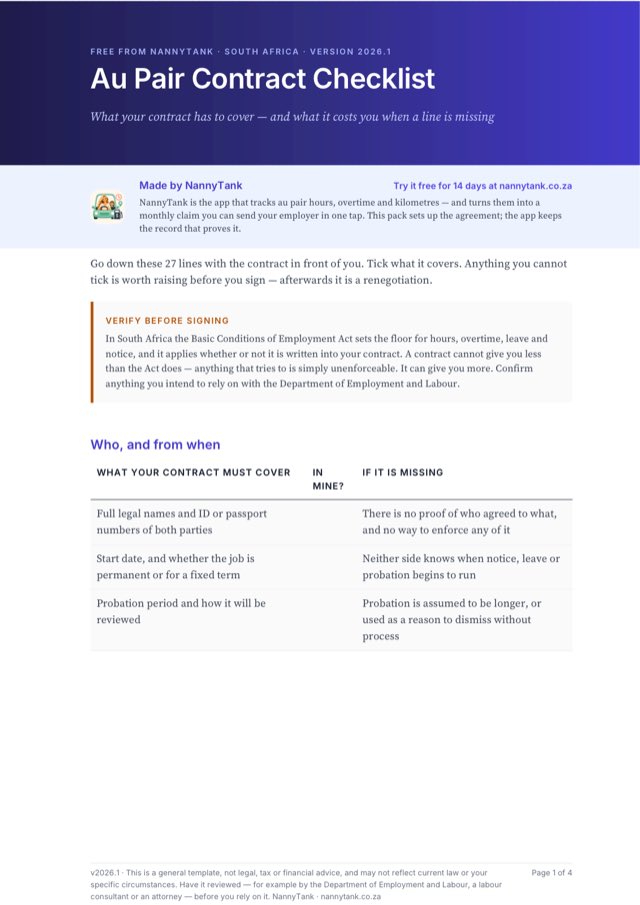
Our Interview & Reference Kit has all of this ready to use: the ten-minute first call, a full scenario question set, the reference call script, a trial day plan with an observation sheet, a checks and documents checklist for your country, and a shortlist sheet to compare candidates side by side. When you have chosen, the Au Pair Contract Pack turns the job you described into an agreement you both sign.
This is a practical guide, not legal advice, and the legal section covers South Africa only. Forms, turnaround times and procedures change — confirm anything you rely on with the Department of Employment and Labour, the Department of Social Development, the Department of Justice or SAPS. Case and legislation summaries are ours; read the source before relying on them.
Start your 14-day free trial at nannytank.co.za.